Contact Us

| Author-level metrics are citation metrics that measure the bibliometric impact of individual authors, researchers, academics, and scholars. Many metrics have been developed that take into account varying numbers of factors from only considering the total number of citations, to looking at their distribution across papers or journals using statistical or graph-theoretic principles. The metrics covered in this guide are H-index, i10-index. and g-index. (Wikipedia, 2025, Creative Commons Attribution-ShareAlike 4.0 License) |
Tools Quick Access
Key Considerations
- Author- level metrics have been criticized as they are susceptible to "gaming the system" through the use of self citation (i.e. citing your own works to increase citation counts) and/or coercive citation (i.e. the process of editors and publishers requiriing unnecessary citations before acceptance to increase counts).
- The focus on metrics can slow the progress of research by impacting the decisions of grant funders.
- The quantity of publications by an author is not necessarily a good metric as many fields now have longer author lists and shorter articles which impacts the numbers.
Author-level Measurements Explained
What is the H-index?
The h-index is an author-level metric that measures both the productivity and citation impact of the publications. The index is based on the set of the scientist's most cited papers and the number of citations that they have received in other publications.
https://en.wikipedia.org/wiki/H-index
H-Index - Calculation

The h-index of a publication is the largest number h such that at least h articles in that publication were cited at least h times each. For example, a publication with five articles cited by, respectively, 17, 9, 6, 3, and 2, has the h-index of 3.
The h-core of a publication is a set of top cited h articles from the publication. These are the articles that the h-index is based on. For example, the publication above has the h-core with three articles, those cited by 17, 9, and 6.
The h-median of a publication is the median of the citation counts in its h-core. For example, the h-median of the publication above is 9. The h-median is a measure of the distribution of citations to the articles in the h-core.
Finally, the h5-index, h5-core, and h5-median of a publication are, respectively, the h-index, h-core, and h-median of only those of its articles that were published in the last five complete calendar years.
We display the h5-index and the h5-median for each included publication. We also display an entire h5-core of its articles, along with their citation counts, so that you can see which articles contribute to the h5-index. And there's more! Click on the citation count for any article in the h5-core to see who cited it.
H-Index - Sources
- Google Scholar is a freely accessible web search engine that indexes the full text or metadata of scholarly literature across an array of publishing formats and disciplines.
- Scopus is an abstract and citation database with enriched data and linked scholarly literature across a wide variety of disciplines including science, technology, medicine, social science, arts and humanities.
- Web of Science is a collection of citation indexes representing the citation connections between scholarly research articles found in most globally significant journals, books, and proceedings in the sciences, social sciences and art & humanities. Updated daily (Monday through Friday).
Limitations
- The h-index does not account for the number of authors of a paper.
- The h-index does not account for the different typical number of citations in different fields, e.g. experimental over theoretical. Citation behavior in general is affected by field-dependent factors, which may invalidate comparisons not only across disciplines but even within different fields of research of one discipline.
- The h-index discards the information contained in author placement in the authors' list, which in some scientific fields is significant though in others it is not.
- The h-index can be manipulated by coercive citation, a practice in which an editor of a journal forces authors to add spurious citations to their articles before the journal will agree to publish it.
- The h-index can be manipulated through self-citations, and if based on Google Scholar output, then even computer-generated documents can be used for that purpose, e.g. using SCIgen.
- The h-index can be manipulated by hyperauthorship. Recent research shows clearly that the correlation of the h-index with awards that indicate recognition by the scientific community has substantially declined.
What is the i10-index?
The i10-index is a metric created by Google Scholar and used in Google’s My Citations feature. This very simple measure is only used by Google Scholar, and is another way to help gauge the productivity of a scholar.
i10-index - Calcuations
i10-index = the number of publications with at least 10 citations. For example, a researcher has published 8 papers with the following citation counts
- Paper 1: 120 citations
- Paper 2: 90 citations
- Paper 3: 18 citations
- Paper 4: 16 citations
- Paper 5: 18 citations
- Paper 6: 5 citations
- Paper 7: 1 citation
- Paper 8: 3 citations
Since 5 papers have at least 10 citations, the i10-index = 5
The following is an example of the i10-index in Google Scholar. Dr. Zumbo has an i10-index score of 272. This means 272 of his articles have at least 10 citations from other authors.

i10-index - Source
-
Google Scholar - provides a simple way to broadly search for scholarly literature. To find your i10-index, create a Google Scholar Profile. For more information on creating a profile, go to the Creating and Managing Your Academic Profile Guide.
Limitations
-
Used only in Google Scholar
What is the g-index?
The g-index is a variant of the h-index that, in its calculation, gives credit for the most highly cited papers in a data set. In the words of Leo Egghe, its inventor:
“Highly cited papers are, of course, important for the determination of the value h of the h-index. But once a paper is selected to belong to the top h papers, this paper is not “used” any more in the determination of h, as a variable over time. Indeed, once a paper is selected to the top group, the h-index calculated in subsequent years is not at all influenced by this paper’s received citations further on: even if the paper doubles or triples its number of citations (or even more) the subsequent h-indexes are not influenced by this.”
g-Index - Calculations
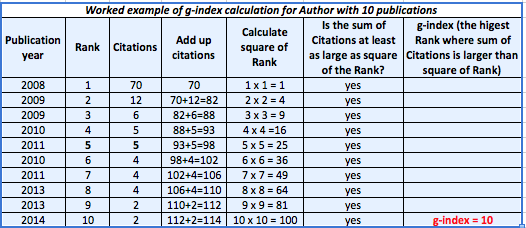
The index is calculated based on the distribution of citations received by a given researcher's publications, such that given a set of articles ranked in decreasing order of the number of citations that they received, the g-index is the unique largest number such that the top g articles received together at least g2 citations. Hence, a g-index of 10 indicates that the top 10 publications of an author have been cited at least 100 times (102), a g-index of 20 indicates that the top 20 publications of an author have been cited 400 times (202).
Wikipedia, g-index, Licensed under CC By SA 4.0
The g-index is always the same as or higher than the h-index.
g-index - Source
-
Publish or Perish is a software program that retrieves and analyzes academic citations. It uses a variety of data sources to obtain the raw citations.
Limitations
-
Introduced in 2006. Debate continues whether G-index is superior to H-index. Might not be as widely accepted as H-index. Review - (Manjareeka, Jan–Mar 2023)
